
Preparing for doctor's appointments with AI
Doctor appointments are precious. Use AI to describe observations made by you or your family more clearly at a doctor’s appointment.
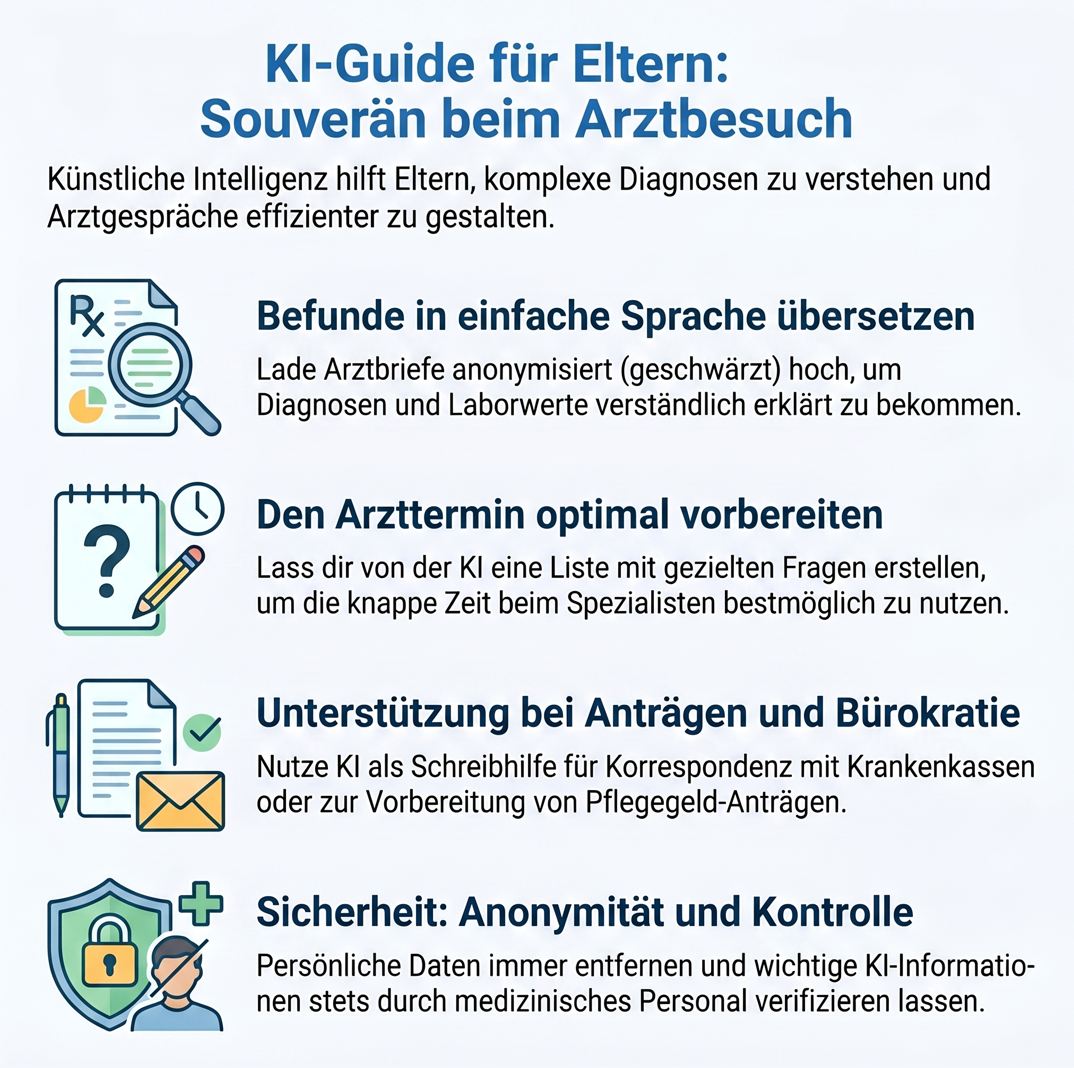
If you have noticed something, or are worried that something is not right with your child, you can use AI to help you put it into context.
Current accuracy ranking of the most common LLMs for medical questions
- Perplexity
- ChatGPT
- Gemini
Describe your observation as precisely as possible and also state your child's age and sex. This can matter for a correct assessment – especially with genetic conditions. Question for the AI, e.g.: I have noticed the following in my child. Which conditions could this be related to?
Upload doctors' letters and reports – always redacted, i.e. without personal data – to learn more about a diagnosis.
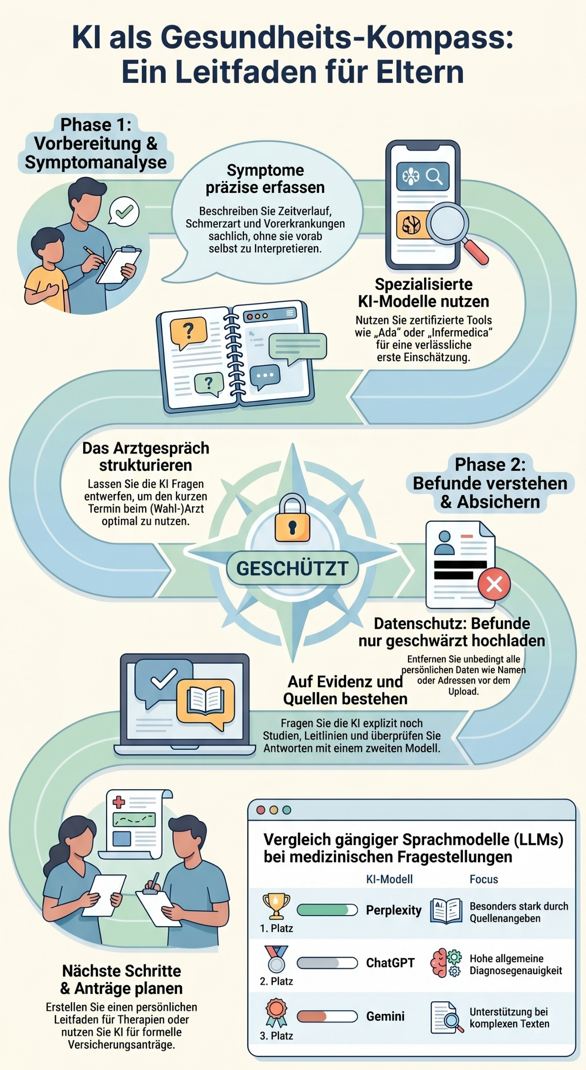
Tip: don't always use the same LLM.
Prompting tips – which questions should I ask:
To avoid hallucinations – i.e. wrong answers – always ask follow-up questions, e.g.
- Is this evidence-based? Are there studies on it? Is it in the guidelines?
- What are possible diagnoses?
- What are the symptoms often confused with?
- What still needs to be clarified to reach a reliable diagnosis?
The more precisely symptoms can be described, the better the treatment. This is especially important for expensive and hard-to-get private specialist appointments.
Recommendation: To be safe, double-check with a second LLM, ask for sources and verify them.
Medical AI models
Certified AI models for checking medical symptoms include, for example:
- “Ada – your health companion” Ada – health app – App Store
- Prof Valmed https://profvalmed.com/ (currently for doctors)
- Infermedica – for an initial assessment of common illnesses Homepage – Infermedica
- Glass Health | Ambient Scribing & Clinical Decision Support – specifically for differential diagnoses
Preparing for the medical appointment
Ask the AI which other questions might be relevant.
- What else can I prepare for the appointment?
- Which documents should I bring?
- Which other questions should I think about?
- Which tests might I expect?
- If a blood test will be needed, should I come to the appointment fasting?
In general, when preparing for medical appointments, describe symptoms as precisely as possible and do not interpret them.
- Describe how things have developed over time.
- Describe the pain
- Has the pain increased?
- Have I travelled recently?
- Do I take any medication?
- Am I female or male?
- Mention height and weight
- Do I have any pre-existing conditions?
- Allergies
- Am I currently taking any medication, and which?
- Have I recently been ill or even had an operation?
- What did I last eat, and when?
When several medicines are taken – especially for family carers – ask about drug interactions. What is being taken and what needs to be watched out for?
Also say who you are: whether you work in medicine, are affected yourself, or care for a relative and are less familiar with the subject. If needed, ask for an answer in plain language.
If you are already facing a diagnosis, you can ask the AI what the next steps are. You can also ask which evidence-based treatment options exist and which check-ups, therapies and examinations are recommended. This way you can quickly put together a personal guide.
Example of a personal guide – created with ChatGPT:
My child has been diagnosed with cerebral palsy. What should I do now?
Tip: Use AI to put communication with insurers, correspondence with the health system, applications, approvals etc. into clear and factual language. You can write your input in any language and have the output in German. Ask the AI to use medical terms correctly and to word the request so that it is legally sound under Austrian law.