Our plan
Once the first shock has been absorbed, the next step is to get familiar with the new situation, make a plan and take action.
Early Intervention – early and intensive therapy that makes full use of the neuroplasticity of a child's brain – is not a sprint but a marathon lasting at least 3 years. Prepare yourself for that. As a parent, you are an important part of the therapy's success!
So you need a paediatrician or neuropaediatrician you trust. They should help ensure that your child receives rehabilitation as quickly as possible – in the first years of life ideally twice a year, for 3–4 weeks – and also evaluate and plan medical interventions with you. In between, you need occupational and physiotherapy and, if needed, speech therapy close to home.
At your medical check-ups, always discuss exactly which examinations should be carried out according to the guidelines, when and how often. For example:
- An MRI to determine the exact extent of the injury and the affected areas of the brain. This can indicate, for example, whether the speech centre is likely to be affected.
- Regular ophthalmological examinations (eye care) are also important
- X-ray examinations of the hips, because children's hips only form properly once they start standing. Children with developmental delays can therefore develop malpositions, which can be counteracted in good time this way.
- Regular paediatric neuro-orthopaedic check-ups and clarification of whether orthopaedic aids are needed – if these are not prescribed during rehab – possibly supplemented by gait analyses in a gait lab.
- EEGs to keep an eye on epilepsy, which very often occurs alongside neurological conditions.
- Optionally, a genetic examination to rule out genetic defects.
As there is currently no neurological centre of excellence and no early intervention programme for children in Austria, the Schön Klinik Vogtareuth in Bavaria is currently the best place to go, as medical treatment and therapy there are interdisciplinary and an intensive early intervention programme is offered from the 3rd month of life. If you are seeking treatment for your child abroad, you need confirmation from a university hospital that it is necessary and an S2 application for the costs to be covered.
List of all neuropaediatric outpatient clinics in Austria for a quick assessment. Alternatively, you can also visit a neuropaediatric practice in private practice for a second opinion.
Which therapies work?
There are many types of therapy, but unfortunately there is still no standard for how to treat cerebral palsy.
This “State of the Evidence Traffic Lights 2019” by Iona Novak et al. review provides an evidence-based guide to the prevention and treatment of cerebral palsy (CP) in children. It analyses the effectiveness of numerous interventions using a traffic-light system and is based on more than 200 systematic reviews published between 2012 and 2019.
The types of therapy marked in green emerged from this study as particularly effective.
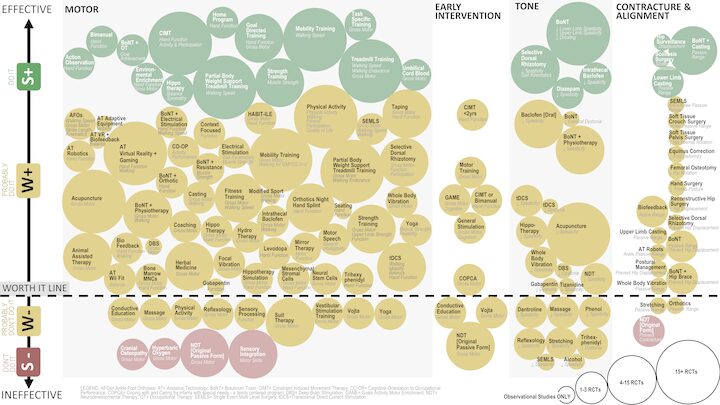
Source and higher resolution: Figure 2 | State of the Evidence Traffic Lights 2019: Systematic Review of Interventions for Preventing and Treating Children with Cerebral Palsy | Current Neurology and Neuroscience Reports