Lucas's family
Our experience with CIMT
Lucas is now 16 months old. He had a stroke before birth, which resulted in right-sided hemiparesis. Like many affected children, he knows no other situation and quickly became quite nimble with his dominant left side. His affected right arm and right hand in particular had so far been consistently ignored.
During a rehab stay at the Schön Klinik Vogtareuth, Lucas was introduced to baby CIMT (a child-friendly version of Constraint Induced Movement Therapy) for the first time as part of occupational therapy. We had not known this form of therapy before and were immediately enthusiastic. Unfortunately, in Germany too, after excellent intensive rehab stays we fall back into a “hole” at home of occupational therapy averaging once a week. Even that is not a given on a regular basis. We, too, were initially told several times things like “Oh, occupational therapy – that's really only done from one year of age at the earliest (…).”
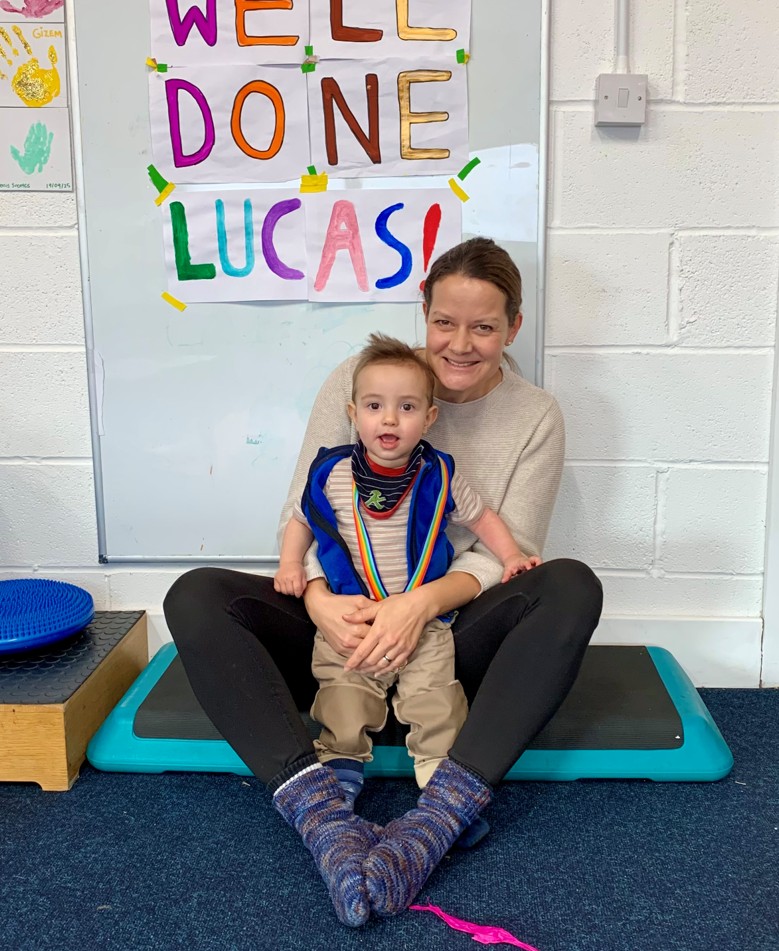
Through Stephanie Schmid and the Early Intervention association, we learned about the possibility of doing CIMT in Manchester, UK, as intensive therapy over several weeks, and we are extremely grateful to this day for being put in touch. After a successful assessment, which checks whether the child is basically suitable for this type of therapy, we spent four weeks in England. Initial concerns, particularly about accepting the cast or whether Lucas might be too restricted in his gross motor skills during that time, quickly disappeared. Looking back, we had a wonderful time there, and in our view Lucas received the best possible therapy for his situation at that point. Two therapists worked with him non-stop for two hours a day. Breaks were also actively used for whole-body movement or at mealtimes (supported “self-feeding”). Lucas really enjoyed the entirely play-based therapy. And for me as his mum, it was wonderful to see what he is actually capable of with his affected right side when the focus is set accordingly. Lucas was able to make both large arm movements and fine motor hand and grasping movements that we had never seen in him before or thought possible.
Even though, of course, Lucas's dominant left side has “taken over” again in everyday life at home, we believe that, given the duration and intensity of the therapy, a certain awareness of the affected side of his body was created and one or two new connections in the brain could be made.
Stefanie Grosche-Radina