Early detection and early intervention: evidence
Scientific evidence
Meta-analyses and randomised controlled trials (RCTs) show clearly: children who receive early support achieve significantly better results than comparison groups. Programmes that are intensive, individually tailored and interdisciplinary are considered the most effective.
The EACD (European Academy of Childhood Disability) is the leading European research network here.
What this means for children and families is described under Basis for the need.
Key studies
CP-EDIT study (Denmark)
The CP-EDIT (early detection and intervention trial) combines early diagnosis using GMA (General Movements Assessment) and HINE (Hammersmith Infant Neurological Examination) with family-centred early intervention programmes such as GO-PLAY (Goal Oriented ParentaL supported home ActivitY program), in which parents are guided in supporting their children at home. It examines the influence of early diagnosis and support on the development of children with CP, as well as on the parents' perspective. CP-EDIT toolkit for parents
The study was carried out at Rigshospitalet (Copenhagen), Aarhus University Hospital, Aalborg University Hospital and Herlev Hospital and includes around 500 infants aged 3 to 11 months, of whom about 300 are followed up until the age of two. It shows: early intervention leads to better motor development, increases parents' confidence and improves children's everyday skills.
Study structure:
- General Movements Assessment (GMA): implementing this assessment in Danish hospitals for the early detection of CP.
- Early diagnosis & prognosis: examining how well early neuromotor examinations predict a reliable CP diagnosis.
- Parents' perspective: qualitative study of the concerns and opportunities parents perceive with an early diagnosis.
Background: early diagnosis enables intervention during a period of maximum neuroplasticity. The aim is to lower the current average age at diagnosis (13 months in Denmark).
Early diagnostic methods: GMA and HINE
The General Movements Assessment (GMA) makes it possible to detect neurological abnormalities from video-based observations as early as 3 to 5 months (corrected age). The absence of “fidgety movements” in particular is considered a strong indicator of CP risk. The method is non-invasive, inexpensive and highly valid in studies. GMA training
The Hammersmith Infant Neurological Examination (HINE) is a standardised examination for children between 2 and 24 months. It was designed by Dr Lilly and Prof. Victor Dubowitz and is now a key tool for the early detection of CP. The HINE comprises 26 items in five main areas:
- Cranial nerve function (e.g. eye movements, facial expression)
- Posture and spontaneous movements
- Muscle tone
- Reflexes and protective reactions
- Behaviour and interaction
Each item is scored, giving a total score. A low score may indicate neurological abnormalities – especially in children at risk of CP (e.g. preterm birth, abnormal GMA findings).
Why is the HINE so valuable?
- Easy to carry out: the examination takes about 10–15 minutes and needs no special equipment.
- High predictive value: in combination with other methods (e.g. GMA, MRI), the HINE can support a reliable CP diagnosis within the first year of life.
- Early therapy planning: the results help to plan targeted early interventions – e.g. baby CIMT in unilateral CP.
Example: what does a score mean? An asymmetry score > 5 may indicate unilateral CP. A total score < 40 at 6 months is associated with a high risk of severe motor impairment.
In the CP-EDIT study, GMA and HINE are used together to enable a sound assessment of CP risk before 6 months of age – and thus to start targeted support as early as possible.
In Norway, work is already under way to diagnose abnormalities with an app, using video analyses that draw on a large database.
Sources: Holland Bloorview – HINE, HINE form in German (Mac Keith Press)
AHA tests
Assisting Hand Assessments for children with unilateral CP measure the abilities of the affected hand and help improve the missing abilities. AHA tests are available as the Mini-AHA for toddlers aged 8–18 months and then as the AHA test from 18 months to 18 years. There is also the BoHA test – Both Hands Assessment.
AHA tests are now considered the international gold standard for assessing the exact range of movement and measuring therapy progress. An improvement is measurable from an increase of 5 units; below that, it may be normal variation.
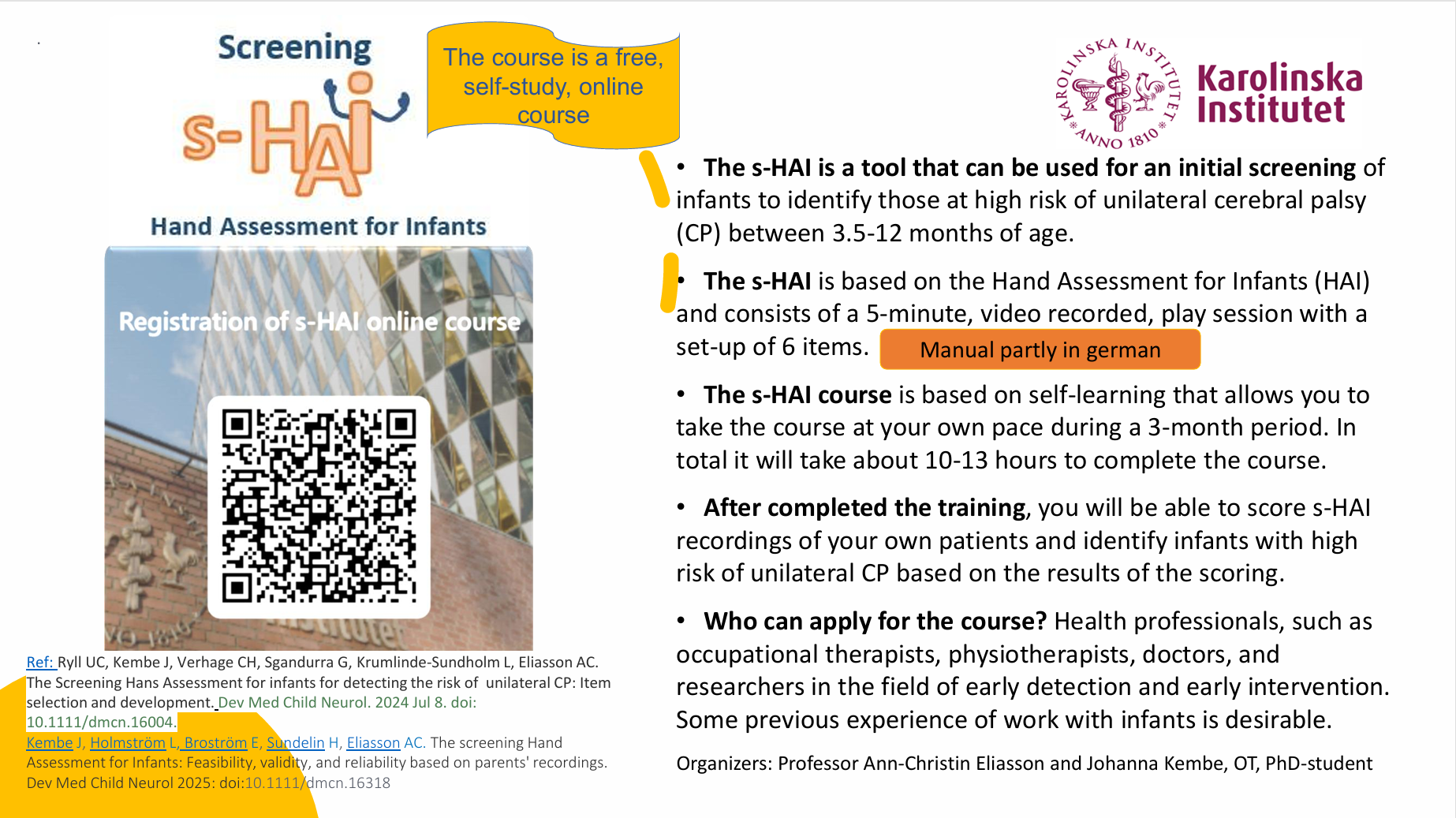
New is the AHA test for infants aged 3 to 8 months, the Hand Assessment for Infants (HAI), which can also be used for early detection.
Training in these tests is available via the Australian platform CP Teaching – Cerebral palsy professional development
or in Sweden at the Karolinska Institutet
LEAP-CP trial (Australia)
As part of the LEAP-CP trial, an intensive, parent-based early intervention programme for high-risk infants under nine months was tested:
- Intensive, parent-led activity training at home
- Significant improvements in gross motor function (GMFM) and perception
- Reduced parental stress
Cochrane analysis of early intervention
A systematic Cochrane review assesses measures used in newborns at increased risk (e.g. preterm birth, lack of oxygen, infections) to prevent CP.
- Key finding: Hypothermia therapy (controlled cooling of the body or brain) in newborns with oxygen deprivation around birth significantly reduces the risk of CP – evidence from 7 studies with 881 children, high quality.
- Other interventions: Many other measures (e.g. medication, ventilation, nutrition) were studied, but the evidence was often inconsistent or of low quality.
- Preterm infants: There are indications that multimodal early interventions (medical + developmental) with parental involvement improve motor and cognitive development, especially in the first year of life – but more research is needed.
Relevance for practice: Targeted early interventions – especially in high-risk newborns – can have a demonstrable effect on CP risk. At the same time, the review shows how important high-quality studies are for identifying further effective measures.
In Austria, Cochrane Austria at the University for Continuing Education Krems works on this. More about Cochrane: www.cochrane.org
CP-North: living with CP in the Nordic countries
The CP-North project analyses the quality of life, health, education and social participation of people with CP across Sweden, Norway, Denmark, Finland and Iceland. The results show that early, coordinated care and family-friendly policies promote health, life satisfaction and inclusion in the long term. More details under Basis for the need.
Therapy, care and standards
Care registers
In Northern Europe, CPUP, a screening and care register, has significantly improved patient outcomes since its introduction. Hip dislocations in children with cerebral palsy, for example, have practically disappeared there. Switzerland also runs such a register, Swiss-CP-Reg, which aims to answer relevant questions by collecting medical data centrally and to improve cooperation between centres. A programme based on this model is highly recommended for Austria.
Evidence-based standardisation of therapy
In Australia, Brian Hoare developed a therapy standard that has already been partly introduced and adapted in Vogtareuth. It uses standardised assessments such as AHA, GMFCS, MACS or BFMF and favours therapy approaches that studies have shown to be particularly effective. These are in particular therapy with Botox and intensive bimanual training to improve motor skills, and SDR surgery to reduce spasticity and prevent contractures. Most studies concern unilateral CP.
State of Evidence Traffic Lights
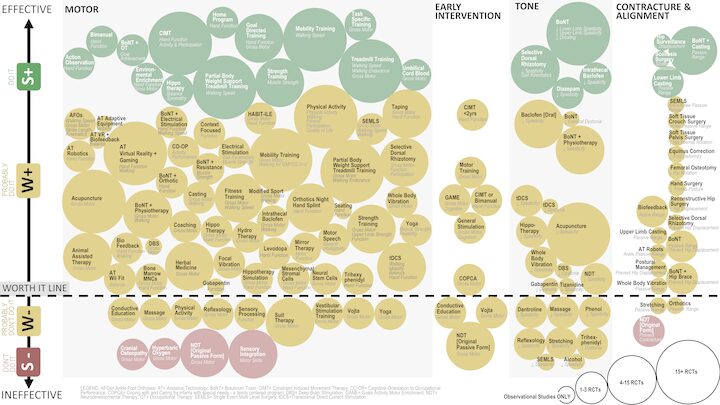
The Traffic Lights study by Iona Novak et al. provides an evidence-based guide to the prevention and treatment of cerebral palsy (CP) in children. It analyses the effectiveness of numerous interventions using a traffic-light system and draws on more than 200 systematic reviews published between 2012 and 2019.
The types of therapy marked in green emerged from this study as particularly effective.
Further studies
Morgan, C. et al. (2021). Early Intervention for Children Aged 0 to 2 Years with or at High Risk of Cerebral Palsy: International Clinical Practice Guideline Based on Systematic Reviews. JAMA Pediatrics. https://doi.org/10.1001/jamapediatrics.2021.0878
Boyd, RN., Greaves S., et al. (2025). Randomized Comparison Trial of Rehabilitation Very Early for Infants with Congenital Hemiplegia. J Pediatr. doi: https://doi.org/10.1016/j.jpeds.2024.114381
Jackman, M. et al. (2021). Interventions to improve physical function for children and young people with cerebral palsy: international clinical practice guideline. Developmental Medicine & Child Neurology. https://doi.org/10.1111/dmcn.15055
Greaves, S., Hoare B (2024). Upper Limb Therapy for Infants and Young Children with Unilateral Cerebral Palsy: A Clinical Framework. J Clinical Medicine. https://doi.org/10.3390/jcm13226873
Orton, J. et al. (2024). Early developmental intervention programmes provided post hospital discharge to prevent motor and cognitive impairment in preterm infants. Cochrane Database of Systematic Reviews. https://doi.org/10.1002/14651858.CD005495.pub5